Showing posts with label Singapore. Show all posts

Friday, January 28, 2011

Eating Singapore: Rojak

As you know, I ate A LOT of food in Singapore.  Like a small child's weight in food.  And while I enjoyed Hainanese chicken rice and drooled over banana fritters with kaya, the single food I thought was most memorable, most delicious, most fantastically awesome is this ugly mess of a dish called rojak.


Rojak is a fruit salad -- yes, that's fruit under that mound of sauce! -- but it's not some prissy fruit salad: it's a sweet, sour, savory, spicy POW of a fruit salad.  Scratch that.  It's a flavor experience.


Rojak is Malay for "mixture."  And that's exactly what this salad is: a weird mixture of stuff that really, really, really should not be delicious together.  Rojak commonly has jicama, pineapple, cucumber, green mango, taupok (deep-fried tofu), beansprouts, and youtiao (Chinese-style dough fritters).  Sometimes there's even squid!


But what makes this melange delicious is the even weirder dressing, which is made with varied ingredients, including tamarind, belacan (shrimp paste), sugar, chili, and lime juice.  I know it doesn't sound at all yummy, but trust me when I tell you that this sauce is bombtastic.  It's so good, in fact, that I seriously licked the plate after devouring all the fruit.


While we had rojak at a few places, the very best iteration we had was at Toa Payoh Rojak at the Old Airport Food Centre, which we found through my favorite Singapore food blog, "I Eat Shoot Post."  TPR operates out of a tiny space, just enough room for the two people (son and mother?) who operate it.    There's such a long wait for the rojak here that you have to take a number and wait . . . and wait.

This is because they make each order a la minute.  The guy toasts the youtiao and chopped peanuts over a charcoal grill, while the tiny, stooped-over elderly woman peels the jicama by hand and chops all the fruit.  He then mixes the sauce according to your spice specifications (hot or mild), then puts everything in a wooden bowl and tosses it by hand.

It's so humbling to watch these two people quietly at work, executing a dish that they've perfected.  Eating it, you taste all of the fresh ingredients, the secret dressing recipe (that's been passed down through the generations), and the earnest dedication of these people to serving the very best version of their prized dish.

Have you tried rojak?  If someone put squid in your fruit salad, would you run away screaming, or pick up a fork and dig in?

Read more...

Wednesday, January 26, 2011

Eating Singapore: Desserts

It's an icy, slushy mess outside on another ugly Boston winter day.  But here on my blog it's still 88 degrees and a perfect time for icy desserts!


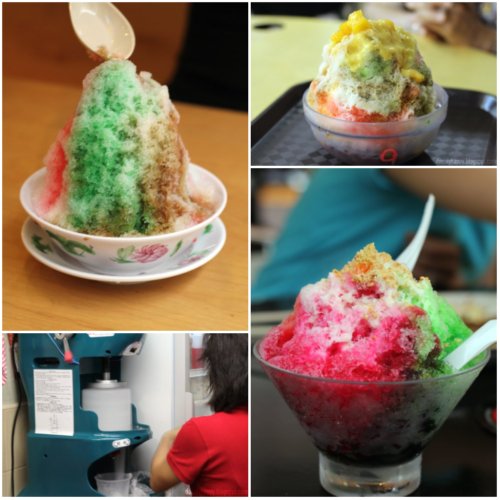
Since it's hot all year long in Singapore, it stands to reason that the most popular Singaporean desserts are  served over ice.  While I'm not a huge fan of icy desserts, my mom and sister have a seemingly insatiable appetite for this stuff.  My mom's favorite is cendol, which is made with coconut milk, shaved ice, palm sugar, and syrup.  The funky-looking green substance on top is a jelly made from pandan leaf and rice flour.  It's like a more sophisticated, chewier, and more filling snow cone.


My sister, however, loves ice kacang, which is also a dessert that involves shaved ice, flavored syrups, and red bean.  As evidenced by these photos, we had a lot of ice kacang.  Some places serve it with corn, others with mango or durian, still others with red beans, grass jelly, aloe vera, attap chee (palm nuts), or even ice cream.  All, however, begin the same way: with a huge bowl of ice that is freshly shaved off a cylinder (like an icy version of gyro, no?).


If you like your ice with more fruit, the above dessert, from Blue Ginger, is a shaved ice topped with coconut and calamansi, a citrus fruit.


And this version from the Maxwell Food Centre has mango, mango syrup, aloe vera, and attap chee.  I'm a huge fan of attap chee, which is the translucent, jelly-like fruit of the nipah palm; it doesn't have a strong flavor -- maybe a hint of coconut -- but it's got a very satisfying snap, sort of like eating a gummy bear that's been refrigerated for a while.


My favorite icy dessert from this trip, though, was probably gula melaka, which has sago (a tapioca-like substance), palm sugar syrup, and coconut milk.  It has a rich, caramel-like taste, and the sago is chewy and gives the dessert a bit more texture and heft than the versions that have only shaved ice.

Are you a big fan of iced desserts?  When you're staring at freshly fallen snow on the ground, are you tempted to stick out your tongue and taste it?  (Jellyby likes nothing more than to eat fresh snow!) Or are you (like me) a bigger fan of baked goods, fresh from the oven?

Read more...

Tuesday, January 25, 2011

Eating Singapore: Sweet Snacks, or All About Kaya

I am sure you must have been drooling in anticipation for the next installment of my "Eating Singapore" series.

Oh.  I think that was actually me drooling.

In any event, we're up to my favorite class of food: sweet snacks!  Singapore totally gets my palate on this front, being that the first snack item I encountered there was banana fritters with kaya fondue.


For this dish, the geniuses at the Gluttons Bar and Sweet Spot at Makansutra Gluttons Bay have taken sweet plantains, fried them, and served them with a dipping sauce of kaya (a delicious jam made out of coconut milk, pandan leaves, egg, and sugar).  The fritters themselves are pretty awesome: a crispy, light coating enveloping a sweet, melt-in-your-mouth plantain.  But dipping them in the kaya makes them totally out of this world.  I could have eaten the whole plate by myself, but my sister forced me to share.


I know that when it comes to battering and frying food, Americans are supposed to be the champs, but everywhere we went in Singapore, we saw stands touting banana fritters, and each one I tried, with or without the kaya fondue, was amazing.  At this stand in the Old Airport Food Centre, for example, they sold nothing but banana fritters, and they were doing brisk business at dinner hour with lots of fried-food lovers clamoring for some plantain goodness.


Well, sometimes deep-fried fruit is too healthy.  That's when you have to get your kaya kick on toast instead, like the kaya fondue with toast sticks at Gluttons Bar and Sweet Spot.


Kaya toast is the quintessential Southeast Asian snack food: decadent, not too filling, and highly portable.  At Ya Kun, a chain kopitiam (coffee shop) famous for their kaya toast, the little old ladies behind the counter toast wheat bread on a countertop grill, carefully divide the toast into two super thin slices (it's like watching someone pull apart two layers of kleenex -- they are so delicate with it), brush on a thin layer of butter, and schmear on a generous amount of kaya.


They treat the kaya toast like it's some art form: the butter has to be cold (they put it back in the fridge between every order), the bread super thin, and the kaya room temperature.  The composition is delicious (though, as my sister points out, not nearly as delectable as the version we had in Thailand).

Have you had kaya?  Are you a fan?  Are you drooling thinking about the dessert post I'm putting together next?  Or is that still me?

P.S. Intrigued by kaya?  Susan Feniger of "Top Chef Masters" fame has a recipe for kaya toast that is supposedly the bomb.  (It's the top-selling dish at her restaurant, Street.)  I haven't tried it yet, but if you beat me to it, please share your results.

Read more...

Wednesday, January 12, 2011

Eating Singapore: Savory Snacks

We have a nor'easter here in Boston, which makes this the perfect time to reminisce about the 80-degree weather in Singapore and to continue my Eating Singapore series.


I'm a big fan of snack time.  Given the choice, I'd much rather nosh my way around town than actually sit down for a full meal.  (Then again, why choose?  Given my seemingly endless stomach capacity for good food, I'm not too worried about "ruining my appetite by snacking.")  


My favorite Singaporean snack, ever since I was a little girl, is satay, charcoal grilled meat skewers.  Back in the day in Singapore, THE place to go for satay was a section of Beach Road called "Satay Club."  All the open-air hawkers there sold satay, and (as my mom fondly recalls), you'd get charged at the end of your meal when the vendor would settle the accounts by counting the number of wooden skewers left on the table.  (Naturally, people tried to cheat the vendors by throwing the skewers on the floor or pocketing them!)  


Alas, Satay Club is no longer, but one of the original hawkers has set up shop under the name "Old Satay Club" at Makansutra Gluttons Bay.  I love that they present their satays in banana leaf cones.  Garnishing every plate are cubes of sticky rice and diced cucumbers, both of which are designed to be speared with a satay skewer and dipped into the spicy, garlicky peanut sauce that accompanies the dish.


We also tried the famous satay at Chuan Kee Satay at the Old Airport Road Food Centre.  Unlike the satay at Makansutra, which while pretty was kind of tough, the satay at Chuan Kee is so tender it literally melts in your mouth.


These folks are so serious about the quality of their satay that they grill them right as you order them.  Accordingly, there's always a huge line.  And they serve it with a sauce that is lick-your-plate-clean good: it's a small bowl of intensely flavored peanut sauce with a heaping dollop of minced garlic in the middle for a pungent, spicy, nutty, sweet kick.


For some reason, Singaporeans are also really into chicken wings.  I'm kind of "meh" about chicken wings, but my sister, who can't resist trying anything there's a line for, got these wings at FoodRepublic and claims that, with a squeeze of the lime-like calamansi, they are quite delish.


I, however, like to save room for the unusual, like these kueh pie tee ("top hat") cups we tried at Blue Ginger.  The pie tee cups are like crispier, lighter versions of mini pate brisee shells.  They are made with rice flour and deep fried in metal molds that have the shape of upside-down cannelles.


The initial crunch of the delicate shell gives way to the tender mix of bamboo shoots, turnips, and shrimp.  It's sweet, savory, and spicy.  


My mom's all-time favorite street snack, however, is popiah, which is sort of a Singaporean burrito.  Well, it's not really Singaporean, in that it actually originates from the Chinese province of Fukien (where my grandpa is from).  But immigrants from China brought the dish with them to Singapore, and now it's super popular in the Straits.


Popiah consists of a thin crepe made from wheat flour, which is then wrapped around goodness such as jicama, turnip, eggs, bean sprouts, meat, and seafood.  What makes the dish pop is a spicy hoisin sauce that gives a sweet and savory "bite" to the popiah.  We had the dish at various food centers, including Maxwell and FoodRepublic, the latter of which was deemed superior by my popiah-loving mom.  (She's not the only one in the family who pines nostalgically for popiah: my grandpa has spent hours in Xiamen, China, searching for the best popiah maker and has imported box-loads of popiahs from Fukien to Hong Kong.)

In my next installment, sweet snacks and desserts!

Read more...

Snapshots from Singapore

With the Totally Rad Lightroom presets, I finally got around to editing some of my non-food photos from Singapore.

A close-up of the tower at the Hindu temple


View of the blue buoys off Marina Bay

The Chinese temple

A lantern at the Chinese temple


The full tower at the Hindu temple

Aren't the colors and details amazing?  I can't imagine how long it must have taken the artisans to create this tower.

Read more...

Wednesday, January 5, 2011

Eating Singapore: Hainanese Chicken Rice

Anthony Bourdain calls Hainanese chicken rice "the national dish" of Singapore, "a light and beautiful thing."  With a commendation like that, how could we not make room for this dish on our culinary tour of the Straits?  Of course, we couldn't just eat any plate of Hainanese chicken rice; we had to get our hands on the very plate of chicken rice that rocked Bourdain's world.


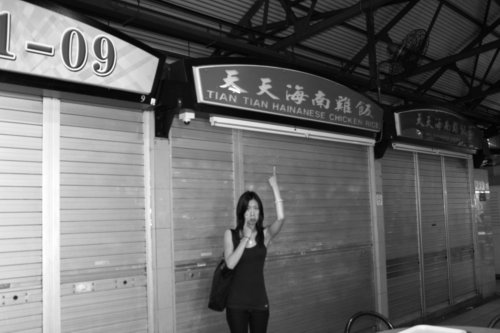
Okay, not the exact plate.  He ate that one.  But in our effort to try the best specimen of Hainanese chicken rice, we went to Tian Tian Chicken Rice in the Maxwell Food Centre, Bourdain's favorite chicken rice stall.  

And oh was it good.  


But I'm getting ahead of myself.  Eating at Tian Tian involved an arduous, sometimes heartbreaking journey.  It required commitment, dedication, perseverance.  


We showed up to the Maxwell Food Centre on a Monday evening, expecting to fill our bellies with chicken rice.  Alas, while all the other hawker stands around it were open, Tian Tian was very much not.  Although I checked its hours of operation, it never occurred to me to figure out its days of operation.  Turns out it's closed on Mondays.  Maybe that's the day it offers sacrifices to the poultry gods.


Not ones to be easily deterred, we showed up again the next day.  This time, we had already eaten lunch, but I'd heard that Tian Tian at lunch hour resembles a Soviet bread line, so I figured showing up a little later would be wise.  But even at 3 pm on a random Tuesday afternoon, the queue for Tian Tian stretched around the storefront.  And even though they had several hours of business left to go, they'd already run out of dark meat.


But that was fine, because after watching everyone around us happily shoving chicken rice into their mouths, we were excited to eat any part of the chicken.  Heck, as you can see in the above photo, my sister was about to eat any person standing in close proximity to the chicken.


At Tian Tian, you place your order at the first window, and as the guys inside the tiny kitchen fill a platter with rice and chicken, you wait under the poster of Bourdain, drooling as plate after plate of chicken rice leaves the kitchen for some lucky fool who got there before you.  After receiving the rice and chicken, you can deal with the condiments, putting the thick soy sauce and house-made chili sauce either directly on the platter of rice or in little plastic condiment cups. 


I'm not huge fan of Chinese-style steamed chicken, but Tian Tian's chicken was darn good. Chicken for Hainanese chicken rice is always served room temperature.  From what I understand, the secret to Tian Tian's recipe is that they boil the chicken whole, plunge it immediately into an ice bath to separate the skin from the meat, and then pour a healthy amount of intense, fatty chicken stock on the chicken right as they serve it (hence the glossiness of the chicken).  I don't know what Bourdain meant by "light," because this is not a diet meal.


My mom, who never met a chicken bit she didn't like, also ordered a plate of non-descriptly named "chicken parts," which I think included chicken gizzards and liver.  It's not my cup of tea -- er, plate of chicken -- but Tian Tian's condiments (see below) were so good that I welcomed having another reason to funnel chili sauce in my mouth.


While the chicken and its assorted bits were good, the rice is the star of the show.  The rice is made with chicken stock and chicken fat; it's coated in flavorful, almost buttery goodness, and is, as Bourdain said, "so flavorful and delicious that it can be eaten on its own."


Well, not exactly on its own.  To transform it from great to outstanding, pour a generous amount of sweet dark soy sauce and the house-made chili, garlic, and ginger sauce all over the rice.  Then spoon a generous amount of all of it into you mouth.  Chew, swallow, smile.  Repeat.


The rice was so good that we ordered a second plate of it (and this is after we'd already had a full lunch, remember?).  

Up until we went to Tian Tian, I never quite got the appeal of Hainanese chicken rice.  It's a dish I've had many times in the U.S. and Hong Kong, but it always seemed kinda meh.  But now I totally get the mystique of this dish: it's humble, homey, comforting food, as personal as it is national.  The Straits' equivalent of apple pie.

I have to go lick the screen now.  Stay tuned for my next post, which will be on Singaporean snacks.

Read more...

Monday, January 3, 2011

Eating Singapore: Starches

Eating non-stop for three days is like running a marathon.  (Ok, I don't run unless I'm being chased, so I'm just speculating here.)  It's hard work, and you have to carbo load to prepare.  Fortunately, Singapore offers a number of delicious starches, from noodles to radish cakes to the most iconic of Singaporean dishes, "Hainanese" chicken rice.


Among the most classic of hawker dishes is char kway teow.  It's so central to Singaporean street cuisine that there's a whole book on it.  Char kway teow is the transliteration of the Hokkienese phrase for "stir-fried ricecake strips."  It involves stir-frying flat rice noodles with a flavorful blend of chilis, belacan (shrimp paste), soy sauce, and various accoutrements such as egg, shrimp, bean sprouts, and oysters or cockles.  


We had ours from the very popular Lao Fu Zi Fried Kway Teow, a stall at the Old Airport Food Centre. Fresh from the wok, their version is perfectly al dente, with a ton of belacan and snappy bean sprouts.  Fried kway teow is probably not my favorite dish of all Singaporean dishes, but Lao Fu Zi's is among the better iterations of the dish that I've had.


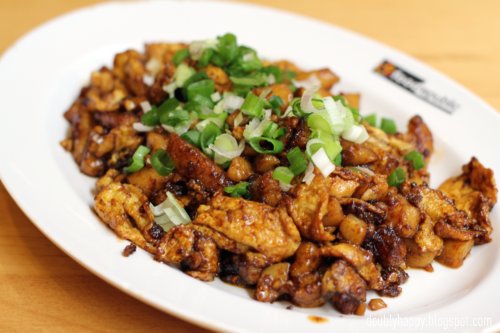
Far more tasty in my opinion is chai tow kway (sometimes char kway) or "fried carrot cake."  No carrots are actually in this dish.  The "cake" is created by mixing rice flour and daikon radish, and large slices of it are eaten pan-fried for breakfast or for Chinese New Year.  For chai tow kway, the "carrot cake" is diced into small pieces and stir-fried with eggs, garlic, spring onions, and soy sauce.  My favorite is the "black" version of char kway, which uses dark sweet soy sauce.  There's also a "white" version, which has fish sauce and light soy sauce.


We tried this dish from the Huat Huat stall at Makansutra Gluttons Bay and from the FoodRepublic at the Wisma Atria Shopping Centre on Orchard Road.  Both were equally delicious.  The sweet soy sauce is savory and sweet, and the "carrot cake" has the texture of very fluffy gnocchi -- it just melts in your mouth.  Combined with the crispiness of the egg and the fresh spring onions, the dish is heavenly.


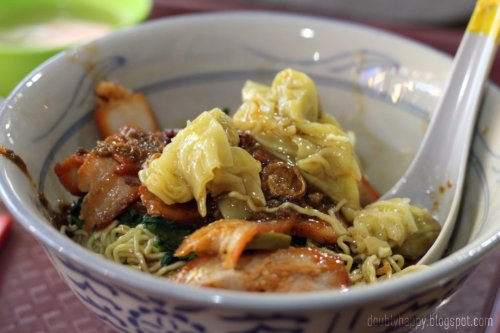
What might possibly top even char kway, is this humble bowl of wonton noodles from Hua Kee Hougang Famous Wanton Mee at the Old Airport Food Centre.  When a fellow eater at the hawker centre recommended this stall to us, we scoffed: "Wontons? We have that in Hong Kong, and I'm not going to waste time or stomach space eating that here."  But as we were leaving the centre -- after we'd filled our bellies with multiple courses, including dessert -- we saw a long line in front of Hua Kee and we just knew we had to taste this "famous" wanton mee.

Hua Kee's wanton mee is a "dry" version, which means that it's not served in soup.  The wantons are good, and the noodles are well-cooked, but what makes this bowl amazing is the sauce that they mix it with.  I don't know what's in the secret recipe, but I tasted sweet soy sauce, vinegar, sesame oil, and chilis.  It tastes sweet, savory, spicy . . . completely unreal.


But if a noodle soup is more your thing, then you need to taste Singaporean laksa.  Laksa is a spicy noodle soup.  There are different varieties of laksa, some (like the one above from FoodRepublic) with coconut milk and some (like Penang laksa, which is a tart version with tamarind) without.  There's nothing as satisfying as a bowl of laksa for breakfast: it has noodles, egg, tofu puffs, fish balls . . . everything you need for a kickass start to the day.

Excuse me while I go cry in a bowl of cold cereal now.

In tomorrow's post . . . chicken rice!

Read more...

Sunday, January 2, 2011

Eating Singapore: Seafood

After many weeks of traveling and eating, I find myself back in Boston, with a half-empty fridge and a growling tummy.  Nothing to be done, I suppose, other than to revisit past gastronomic glories . . . .

My gluttonous exploits in Singapore left me with an extra five pounds and a hefty number of photos.  Since we tried various iterations of our favorite dishes, rather than describing the eats chronologically or by restaurant, I thought I'd go by genre, starting with Singapore's gorgeous seafood.


Singaporeans do amazing things to mollusks.  Mussels, clams, conches . . . if it has a shell, they find a way to make it taste delicious.  At the hawker center at Makansutra Gluttons Bay, my mom insisted that we try the fresh cockles.  The rough-looking dudes at Boon Tat Seafood quickly wok-steamed the cockles and served it with their house chili sauce.


On first glance, I wasn't that impressed.  But you crack open the shell, use a toothpick to spear the delicate meat, dip it into the sauce, put it in your mouth and . . . a huge punch of flavor hits you.  The brininess of the cockles was so intense and savory that I swore up and down that there was a black bean sauce infused into the dish.  My mom -- and a quick look at the menu -- confirmed otherwise.  And that calamansi-infused chili sauce is seriously tasty.  (Calamansi is a tiny citrus, sort of like a slightly savory lime, that Singaporeans put in everything.)


Singapore is probably most famous for chili crab.  (For more on this, you have to check out Big Apple Nosh; she experienced crab paradise on her trip to Singapore.)  But I'm a lazy girl, and seeing that no one was offering to crack crabs for me, I decided that crabs involved too much work and ordered a chili black pepper shrimp instead.

Boon Tat's version was good.  No surprise: Singaporean black pepper sauce is a sticky, spicy, savory, and sweet soy and pepper reduction that would be tasty on anything, even a shoe.


For my sister, Singapore seafood is about one thing and one thing only: screw chili crabs, what she wants is grilled monkfish.  And she wants it at just about every meal.

Monkfish is the football player of fish: ugly, hefty, and meaty.  It's got the firm texture of swordfish, and is sometimes described as "poor man's lobster."  Singaporeans and Malaysians figured out how to make it tasty and moist by schmearing it with a thick chili paste, wrapping it in banana leaves, and grilling it.  Served with a twist of calamansi, the monkfish is transformed from fug to fab.


Aside from grilling technique, what makes a great monkfish is the chili paste.  Other than chili, it usually has cilantro, ginger, tumeric, and maybe a bit of belacan (a shrimp paste).  The one at Boon Tat had the perfect combo of heat and savoriness; I was less impressed with the blander version we had a the Old Airport Food Centre (though it did not prevent my sister from eating the whole dish on her own).


By now, it must seem that every seafood dish in Singapore is prepared with calamansi and chili.  But we also had great seafood prepared "nonya" style.  Nonya or Peranakan cuisine is a fusion of Chinese and Malaysian-Indonesian cooking styles, and the Chinese part of the mix tamps down the spice a bit.  The emphasis on the savory and the unami can be a nice respite from the bold chili flavors of mainstream Singaporean food.  At Blue Ginger, we tried "Sotong Kunyit," which is squid stir-friend with tumeric and tamarind.  The squid was perfectly cooked -- al dente, not at all chewy -- and was coated in a subtly spicy, sweet and tart sauce.  

After all this shellfish, I have a lot to repent for on Yom Kippur.  But damn it was delicious!  And did I mention that seafood is super affordable in Singapore?  

Read more...

Thursday, December 30, 2010

Eating Singapore: Best of the Best (and an Intro to the Rest)

Singapore is my birthplace, so it's with not an ounce of bias that I say it's one of the most boring places on the face of the planet: the shopping is overpriced and generic (Chanel across the street from Chanel!), the heat and humidity are unbearable, and everything is intolerably clean and hygienic.  But it's also with not an ounce of bias when I say that it's probably got the best food on earth.

Chendol Ice at Blue Ginger Restaurant

Okay, perhaps I should limit my claim just to saying that Singapore has the best street food culture on earth; when I'm back in Singapore, all I want to do is hover around the covered hawker centers -- the food courts in which the cheapest, most traditional of food vendors ply their goodies -- so I can't tell you what the haute cuisine is like there.  But who needs molecular gastronomy when the most perfect bowl of wonton noodles can be had for less than the price of a Happy Meal?


Toa Payoh Rojak at Old Airport Rd. Food Centre

Singapore's food culture is so rich because it is influenced by European, Malay, Chinese, Indonesian, and Indian cuisines.  Singaporean food is somehow all of these and yet not any one of them in particular.  It's each of these cuisines amped up: more spicy, more savory, more unami, more sweet, and more delicious.

Tian Tian Chicken Rice at Maxwell Road Food Centre

I had two gastronomic goals for this trip: (1) eat only "classic" dishes, the ones of my youth, the ones that my mom will not stop talking about, and (2) attempt to find the best -- the most "authentic," flavorful, famous, well-tested . . . however one wants to define "best" -- of each type of dish.  We definitely succeeded in the first.  And I'm fairly sure we came close to achieving the second.  Either that or even the not-so-great in Singapore is pretty fantastic.

Fried Banana Fritters with Kaya Fondue at Makansutra Gluttons Bay

Precisely because there's so little to do in Singapore, my family and I spent literally all day, every day eating.  We could barely start one meal without thinking about where we were going to eat next.  We're talking at least five meals a day -- so much food that I could scarcely fit into my clothes after three days of exhausting and happy gluttony.

Hua Kee Hougang Famous Wonton Mee at Old Airport Road Food Centre

There's a Singaporean expression, "shiok," which means "really delicious."  I can't wait to share with you the food I ate on this trip; it was awesomely, ridiculously shiok.

Read more...
Related Posts with Thumbnails

Doubly Happy on Facebook

  © Blogger templates Psi by Ourblogtemplates.com 2008

Back to TOP