Showing posts with label Judaism. Show all posts

Sunday, April 24, 2011

Diary of a Secret Housewife: Matzo Lasagna

When you're Jewish, you don't get to hunt for Easter eggs (though I suppose finding the Afikomen comes close) or hang out with the Easter bunny.  But that's not to say we don't have some fun times around this time of year, like figuring out a creative way to eat matzo come the sixth day of Passover, when you've already exhausted all other matzo + topping combinations.  This year, on the advice of a colleague, I discovered matzo lasagna.


I know, I know.  You're skeptical.  As was I.  And I had to counsel my husband to keep an open mind before he would even touch it.

But you know what?  It's delicious.  Moreover, although it tastes like matzo lasagna right out of the oven, once the ingredients come together overnight, the leftovers really taste like regular lasagna.  It's a Passover miracle!  It's actually a solid enough dish that I'd make it even if it weren't Passover.  


 I improvised the recipe based on a number of matzo lasagna recipes on the web.  Once you have the basic procedure down, you can get creative and put together your own favorite lasagna flavors.

Here's what you need at a minimum:


6 matzo sheets
1 (24 ounce) carton ricotta cheese
1 (8 ounce) package shredded mozzarella, asiago, or parmesan cheese, divided
1 (28 ounce) jar marinara (or your favorite jarred or homemade pasta) sauce


Preheat the oven to 350 degrees.  Prepare the matzo by soaking the sheets in hot water for about 30 seconds, or until the matzo is pliable but not mushy.  Don't oversoak, or else they'll break apart.  Then set them on a dish towel and let them rest until they become bendable.

Cover the bottom of a casserole dish with a shallow layer of sauce, then place upon that two matzo sheets (or however many fits neatly in the dish).  Layer upon it half the ricotta, mixed with a sprinkling of the shredded cheese.  Then put on another layer of sauce.  Alternate matzo, filling, and sauce until you get the desired thickness/layers.  Your top layer should be matzo covered with a thick sprinkling of shredded cheese.  Bake the lasagna in the oven for 30-40 minutes until bubbly and delicious.

Improvisations: The above recipe is super basic (and probably not that delicious).  I spiffed it up with my favorite lasagna fillings: ground beef (or meat substitute), four cheeses, fresh herbs, spinach, onions, etc.  For a less Italian-American and more Sephardic take on this dish, try the filling combinations from this NPR article on minas, the Middle Eastern version of matzo lasagna.


Chag sameach!

Read more...

Monday, March 21, 2011

Diary of a Secret Housewife: Hamantaschen

This weekend was the Jewish holiday of Purim, which is awesome for kids (carnival! masks! costumes!) and usually not so much fun for adults.  But I made my own fun by baking my own hamantaschen.   


Hamataschen are triangular cookies, usually filled with poppy seed or fruit jam, that are traditionally served on Purim.  There are various explanations for why they are served on Purim, but usually the story is that they resemble the ears or the hat of Haman, the villain of the Book of Esther, which is the story that gets read aloud at Purim.  Store-bought hamantaschen are usually not so delicious, as most Jewish bakeries are parve, meaning they don't use dairy products, including butter.  I was thus especially psyched to find Smitten Kitchen's recipe, which has butter AND cream cheese!   Whee!


Here's the recipe, with my revisions, adapted from Smitten Kitchen.

Ingredients:
  • 8 tablespoons unsalted butter, softened
  • 3 ounces cream cheese at room temperature
  • 4 tablespoons sugar
  • 1 egg
  • 1 teaspoon vanilla extract
  • Zest of one orange
  • 1/4 teaspoon nutmeg
  • 1 1/3 cups plus 4 teaspoons flour
  • 1/4 teaspoon salt
  • Various jams (I used boysenberry and raspberry) or prepared fillings (such as poppy seed or prune pastry filing)

Directions: 

Cream butter and cream cheese together until smooth. Add sugar and mix for one minute longer, then egg, vanilla extract, orange zest and salt, mixing until combined. Finally, add the flour. The mixture should come together and be a tad sticky. 

Form dough into a disc, wrap in plastic and refrigerate for at least an hour.

Preheat oven to 350°F.


To form the hamantaschen, roll out the dough on a well-floured surface until it is about 1/4-inch thick (I like my cookies more delicate, so I went for a little less than 1/4 inch). Using a round cookie cutter (or just the top of a small bowl) and cut the dough into circles. Spoon a teaspoon of you filling of choice in the center.


Fold the dough in from three sides and firmly crimp the corners and give them a little twist to ensure they stay closed.  Some of my first batch of cookies flattened out completely in the oven, so trust me when I tell you to really crimp the corners tight (you can even brush a little bit of egg on the corners to seal them).  It also helps to refrigerate the folded cookies for a little while before baking, so that they hold their shape a bit more.


Next time I make this though, I'm not going to try to keep the three "walls" standing straight up.  I'm just going fold the three sides in a bit more, almost like a paper football, so that they almost completely cover the jam.  That way, they will hold the triangular shape.


But let me assure you that even if they come out all deformed or flat like mine did, they still taste pretty darn good.  The dough is light, buttery, and flavorful, not dry and hard like parve hamantaschen usually are.

Have you ever made hamantaschen?  Do you have any advice for how to get them to hold their shape?

Read more...

Wednesday, February 23, 2011

Mezuzah Fail

Last week, right before our Chinese New Year party, we finally put up our mezuzah.  We've lived in our house for over a year, and we kept missing opportunities to put up our mezuzah: every time we remembered, it was either shabbat (when you're not supposed to do "work," like installing things) or too late in the evening to be hammering things outdoors.  Since we were thinking of our party as a kind of open house, we really wanted to get our mezuzah up before the soiree.


A mezuzah is a small decorative box that contains a parchment inscribed with verses from the Torah.  It's installed on the doorframe to fulfill the mitzvah (Biblical commandment) to inscribe the words of a Jewish prayer, called the Shema, "on the doorposts of your house."  It's a significant marker of a Jewish household, so we were particularly embarrassed/sad that we hadn't gotten ours up yet.  (According to Jewish law, you're supposed to affix the mezuzah within 30 days of moving in.)


Jellyby, as you can see, was pretty excited about our putting up the mezuzah.


But not as excited as me!  Especially when I managed to locate the blessing you're supposed to say on the occasion of putting up a mezuzah.  (Many thanks to our friend Geri for documenting the process with photos!)


My Hebrew, though, is pretty egregious, so I needed quite a bit of coaching.


After saying the blessing for the mezuzah, we nailed it on the doorpost.  And we said the Shehecheyanu, which is one of my favorite prayers, as it's the one you say to mark a special occasion.


The most important part of the mezuzah is the parchment scroll, which is not visible from this angle, as it's tucked away inside the container.  But it helps that the visible parts of the mezuzah are pretty!  I love the copper, which will hopefully weather and develop a nice patina.  And do you see the purple bits of glass in the tube at the front of our mezuzah?  Any idea where that's from?


It's the glass we broke at the wedding!

I'm happy the mezuzah is up, but we need to move it soon.  In our haste to get the mezuzah up, we nailed it to the left side of the doorframe.  Alas, it's actually supposed to go on the right side.  Since the mitzvah of putting up the mezuzah is not fulfilled unless the mezuzah is installed correctly, we're technically no further along than when we started.  

Total fail.  We feel like complete morons since my husband is a former Hebrew School teacher, and we've installed mezuzahs in our previous homes.

Wish us better luck next time.  Oh, did I mention that we have at least three more mezuzahs to put up?  (One for our back door, one for the patio door, and another for our master bedroom door.)  Please let me get smarter between now and the next round of mezuzah installations!

Read more...

Sunday, December 5, 2010

My Hanukkah Present

This is my niece's first Hanukkah, which, while probably not that exciting for her (she's pretty psyched with a bottle and a tummy tickle), was super exciting for her aunt and uncle.


For weeks I've been thinking of all the adorable, over-the-top Hanukkah presents I could get her.  Perhaps she needs a pair of baby Manolos?  Or a chic Dior onesie?  And I know they make "denim" diapers, but do they make Citizens for Humanities baby jeggings?


Then I thought to myself, "Self, perhaps it would be better not to pass on your shallow, label-loving ways to your niece?  Perhaps, just perhaps, it would be preferable to transmit to her more positive, transcendent values?"


But what presents actually communicate such values?  After much thought, we decided that rather than just giving her material presents, we'd correlate them to the less tangible gifts with which we hope she'd be blessed for a lifetime.  We wished her:
  • for the first day of Hanukkah, the gift of tradition (correlated with a personalized menorah)
  • for the second day of Hanukkah, the gifts of inspiration and creativity (correlated with a box of Hanukkah candles)
  • for the third day of Hanukkah, the gift of love (correlated with a picture frame with a photo of her whole family)
  • for the fourth day of Hanukkah, the gifts of knowledge, wisdom, and curiosity (correlated with the most adorable pop-up book, Chanukah Bugs: A Pop-Up Celebration)
  • for the fifth day of Hanukkah, the gifts of fun and a sense of adventure (correlated with darling little sneaker socks)
  • for the sixth day of Hanukkah, the gifts of comfort and happiness (correlated with a Wubbanub, on the recommendation of blog friend Sara)
  • for the seventh day of Hanukkah, the gifts of charity, empathy, and tikkun olam (the Jewish concept of "healing the world") (correlated with a donation in her name to Mazon, a hunger-relief organization)
  • for the eighth day of Hanukkah, the gift of remembrance, of all the relatives and loved ones who physically or metaphysically couldn't be with her on this special holiday (correlated with a package of post-its . . . because it wouldn't be Hanukkah without at least one stinker of a gift!)
None of these gifts are particularly expensive, but we hope that they -- especially the intangible ones -- will have a more lasting impact on her.  Also, I was thinking that perhaps we could create a tradition by giving her presents that correlate with those particular values each year.

If you celebrate Hanukkah, what meaningful gifts have you given or received this year?

Read more...

Thursday, December 2, 2010

Diary of a Secret Housewife: Baked Sufganiyot

Every once in a while, I'm reminded of how fitting it is that I became Jewish.  I mean, what you have in Judaism is a culture that celebrates one of its most important holidays by frying everything in sight.

That is awesome.

But every year there comes a point in which even the greasiest lover of grease among us becomes a little bit repulsed by things fried.  That point usually comes after standing in front of the stove for hours frying latke after latke until every surface in the kitchen -- and every bit of one's clothing, skin, and being -- is coated with grease.  And when you get to that point when you feel like you've been immersed in one big fryolator, the very thought of heating up one more vat of oil makes you want to run out the kitchen screaming.

That is when you should make these baked donuts.


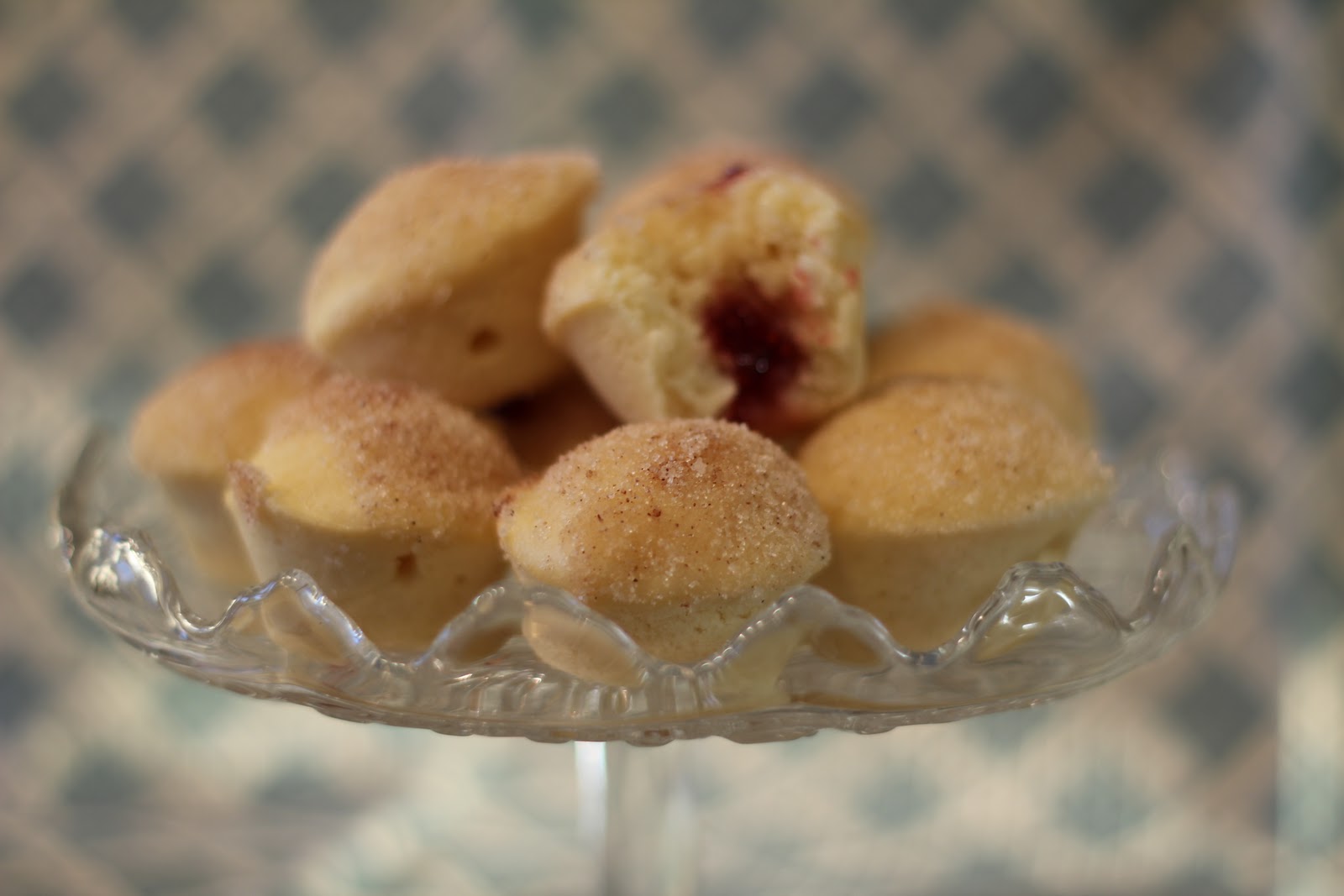
Sufganiyot are Israeli donut balls, commonly filled with jelly (though there are lots of different yummy fillings nowadays), that are traditionally eaten during Hanukkah.  They are usually deep-fried, but I came across this recipe on Baking Bites that calls for baking them.  The result is a mini-muffin (or donut hole) that tastes a lot like a sufganiyot or a chewier, denser cinnamon-sugar donut.


Not being fried, the sufganiyot came out of the oven a bit paler than I expected.  But whereas the baked version doesn't visually compare with the original, taste and texture-wise, it came a lot closer than I expected.  In fact, the cinnamon-sugar topping gives it a crunch that is textually similar to a fried donut.

The following recipe is adapted from Baking Bites.  My changes and additions are in italics.


Ingredients:
1 1/2 cups all purpose flour
2 tsp baking powder
1/4 tsp salt
3/4 cup sugar
1 large egg
1/4 cup vegetable oil
1 tsp vanilla extract
3/4 cup buttermilk
2 tbsp orange zest

2 tbsp butter, melted
1/2 cup sugar
1/8 cup cinnamon (or more, if desired)
2/3 cup red jam (raspberry, strawberry, etc.)

Directions:
Preheat oven to 350F. Lightly grease a mini muffin tin with cooking spray or vegetable oil.

In a small bowl, whisk together flour, baking powder and salt.

In a large bowl, beat together sugar and egg until light in color. Beat in vegetable oil and vanilla extract. Gradually add in flour mixture in two or three additions, alternating with additions of buttermilk.  Then add in the zest, mixing until all the ingredients have come together.

Divide batter evenly into prepared mini muffin cups, filling each about 3/4 full (approx 1 tbsp batter).
Bake for 9-11 minutes, until a tester inserted into the center comes out clean.

Place melted butter in a small bowl. Mix together the cinnamon and sugar and place the mixture for rolling in a small bowl or deep-sided plate.  


Remove donuts from pan, dip the tops in melted butter and roll in cinnamon sugar. Place on a cooling rack to allow sugar to set.

When donuts are cooled, fit a pastry bag with small round pastry tip. Place jam into pastry bag. Poke a small hole in the side (or bottom) of each donut with the pastry tip and pipe a small amount of jam into the center of each donut (approx 1 tsp).

Serve immediately.

Read more...

Thursday, October 7, 2010

Diary of a Secret Housewife: Praline Noodle Kugel

Sorry I've been MIA!  We're in the middle of our living room redo, and I've been besieged by a/v people, boxes, extra furniture, boxes, and more boxes.  The visual chaos has made it totally impossible for me to think, let alone cook or blog.

Enough of the excuses, though.  Since with the exception of one very time consuming brisket, we've been mainly subsisting on take out, it's time to return to the dishes I made for our break the fast party a few weeks ago.

Somehow, I allowed my husband to convince me that despite the many sweets and baked goods we already had for the party, any good break fast must have a noodle kugel.  Rather than going all fusion with it, this time I decided to go as traditional as possible; in fact, I selected a recipe from probably the most classic Jewish cookbook available, Joan Nathan's Jewish Cooking in America.  (Seriously, it's probably on your bubbe's cookbook rack gathering dust right now.  Or it's hiding under the pile of schmatas on her counter.  Go check.)


The recipe is elaborately titled "North Shore Chicago Hadassah's Lick-Your-Fingers Kugel," but I don't like finger-licking near any of the food I serve to guests, so I just call it a praline noodle kugel, because that's basically what it is: caramelized pecans atop a traditional noodle kugel base.

The perks about this kugel recipe is that it's easy and it's quite an elegant presentation: the sugared pecan base flips over to become the top of the kugel (sort of like a pineapple upside down cake), and if you bake it in a classic bundt pan, there's even a nice hole in the middle where you can place a little sumthin' extra, be it flowers, a ramekin of sour cream, or (in our case) some mini peanut butter cups (I needed something to stick the toothpick flag in).

The not-so-great aspect of this kugel is that it's SWEET.  It's good for the first two bites or so, but after that you begin to feel a little gross shoveling butter, oily noodles, and sugar into your mouth.  That said, I guess that's precisely what makes noodle kugel so rich and comforting and such a key component of the break fast table.

Here's what you need:


  • 1 1/2 sticks (3/4 cup) salted butter or margarine
  • 3/4 cup dark brown sugar
  • 1 cup pecans, halved
  • 1 pound wide noodles (Tip: Avoid curly noodles, as they tend to make molding difficult.)
  • 4 large eggs
  • 1 teaspoon cinnamon
  • 1/2 cup sugar
  • 2 teaspoons salt

The recipe itself takes literally just four steps:


  1. Melt half the butter in a 12-cup mold or tube pan. Swirl it around the bottom and up the sides.
  2. Press the brown sugar into the bottom and press the pecans into the sugar.
  3. Boil the noodles according to the package directions and then drain. Mix with the eggs, the remaining butter, melted, cinnamon, sugar, and salt and pour into the mold.
  4. Bake in a preheated 350-degree oven for 1 hour and 15 minutes or until the top is brown. Let sit for 15 minutes before unmolding. The top will become slightly hard like a praline. Serve cold or at room temperature.

Easy!  And it's one of those dishes you can make ahead of time, as well as keep for a day or two after the party.

What's the one dish your family has to have on the holiday table every year, even if it's not exactly finger licking good?

Read more...

Sunday, September 19, 2010

Smashing the Fast

Posting has been light this weekend because of Yom Kippur.  Well, actually, because I was too fixated on my adorable niece who was visiting to attend to anything else.  And so I'm a bit late in offering a thank you to those of you who came to my rescue with ideas about what to serve at our mostly vegetarian break the fast party.


Ultimately, we ended up with a full and pretty darn good (if I do say so myself!) buffet:


I hope you had a lovely weekend.  And for our Jewish friends, an easy fast.  L'shana tova.

Read more...

Tuesday, September 14, 2010

Diary of a Secret Housewife: Rosh Hashanah Honey Cake

This year, we had a fairly low-key celebration of the Jewish New Year, but one thing I do every year, regardless of how many people are coming over for dinner, is make a honey cake.  If you're one of those people who cringe at the thought of a sweet and spicy cake, I'm with you: I'm no big fan of cinnamon (unless it's in the form of a Cinnabon), and I generally dislike cloves, allspice . . . you know, the "apple pie" spices.

But this honey cake is so majestic, so moist that each year I put aside my spice prejudices and make it.  Oh, in fact, it's called "Majestic and Moist New Year's Honey Cake," and it's from Marcy Goldman, who is also responsible for Caramel Chocolate Matzoh Crunch (a.k.a. matzoh crack).


I used Goldman's batter to make cupcake-sized cakes this year, as cupcakes are faster to bake and easier to give away as gifts.  The recipe yields a very liquidy batter, but the result is a cake that is as melt-in-your-mouth on day one as it is on day four.


I served the cupcakes with a little margarine and honey.  They are plenty sweet already, but if you want a sweet new year, you gotta go all out, right?!


Here's the recipe:

Ingredients:
  • 3 1/2 cups all-purpose flour
  • 1 tablespoon baking powder
  • 1 teaspoon baking soda
  • 1/2 teaspoon salt
  • 4 teaspoons ground cinnamon
  • 1/2 teaspoon ground cloves
  • 1/2 teaspoon ground allspice
  • 1 cup vegetable oil
  • 1 cup honey
  • 1 1/2 cups granulated sugar
  • 1/2 cup brown sugar
  • 3 eggs
  • 1 teaspoon vanilla extract
  • 1 cup warm coffee or strong tea (For a Chewish twist, I used a Vietnamese coffee that my mom brought back for me from Saigon.)
  • 1/2 cup fresh orange juice
  • 1/4 cup rye or whisky 
  • 1/2 cup slivered or sliced almonds 

Goldman recommends using a 9-inch angel food cake pan, but says that you can also make it in a 10-inch tube or bundt cake pan, a 9 by 13-inch sheetpan, or three 8 by 4 1/2-inch loaf pans.  (I used a muffin pan that yields 12 cupcakes.)

Preheat the oven to 350°F.  Lightly grease the pan(s).  For tube and angel food pans, line the bottom with lightly greased parchment paper.  For gift honey cakes, Goldman uses "cake collars" (available from Sweet Celebrations) designed to fit a specific loaf pan. These give the cakes an appealing, professional look.

In a large bowl, whisk together the flour, baking powder, baking soda, salt, and spices. Make a well in the center and add the oil, honey, sugars, eggs, vanilla, coffee, orange juice, and rye or whisky.

Using a strong wire whisk or an electric mixer on slow speed, combine the ingredients well to make a thick batter, making sure that no ingredients are stuck to the bottom of the bowl.

Spoon the batter into the prepared pan(s) and sprinkle the top of the cake(s) evenly with the almonds. Place the cake pan(s) on 2 baking sheets stacked together and bake until the cake springs back when you touch it gently in the center. For angel and tube cake pans, bake for 60 to 70 minutes; loaf cakes, 45 to 55 minutes. For sheet-style cakes, the baking time is 40 to 45 minutes. This is a liquidy batter and, depending on your oven, it may need extra time. Cake should spring back when gently pressed.

Let the cake stand for 15 minutes before removing it from the pan. Then invert it onto a wire rack to cool completely.

Note: If you prefer not to use the whisky, replace it with orange juice or coffee.

Chewish or not, make this cake.  You'll love it. A belated l'shana tova to all!

Read more...

Thursday, September 2, 2010

High Holidays, Vegetarian-Style

The Jewish high holidays are coming up, and we're so excited because my absolutely adorable, almost 2-month-old niece is making her first out-of-town trip to spend Yom Kippur with us.  Oh, and her parents are coming too -- 'cuz apparently there's some law that infants can't drive themselves to see their aunt and uncle?

I kid. I kid.  We are pretty thrilled to see her parents too.

In fact, we'll have a number of family and close friends here for the holidays.  But here's my dilemma: we're filling our house with -- oy gevalt -- vegetarians (ok, some pescatarians as well), and I'm going to have to figure out how to update traditional brisket- and chicken-heavy high holiday menus to keep everyone fed and happy.


I have several go-to vegetarian recipes, including the gorgeous panzanella above, a delicious vegetable tian, and my favorite potato pave.  There are also high holiday recipes that are parve (meat- and dairy-free), like noodle kugel.  And for the pescatarians, I have a number of fish entrees I can prepare.  

Sure, as usual with Jews, you can toss a dozen bagels and some cream cheese and lox our way, and we'll be thrilled.  But it'd be nice to get through the holidays without gaining ten pounds from carb-loading.

What I could really use are some additional vegetarian-friendly recipes that are more substantial, less like sides.  I'm wondering if any of you brilliant cooks and eaters out there can offer some suggestions?  We'd be most appreciative!

UPDATE: The New York Times comes to my rescue!  See this.

Read more...

Monday, April 5, 2010

Diary of a Secret Housewife: Caramel Chocolate Matzoh Crunch

Since it's Passover, I've had to do without my all-too-frequent stops at the local bakery for chocolate chip cookies or red velvet cupcakes.  Sure, I could use the holiday as a reason to cut down on my carb and sweets intake and get myself trimmed down for bikini season.  Alternatively, I could use the holiday as an excuse to cover all the "kosher for Passover" items around my house with caramel and chocolate and get myself plumped up to fill in some mumus for the summer.

I chose the latter option.


I made Marcy Goldman's "My Trademark, Most Requested, Absolutely Magnificent Caramel Matzoh Crunch."  With a title like that, you know it has to be awesome.

And it was.


Here's what you need: 4-6 unsalted matzohs; 1 cup (2 sticks) unsalted butter or unsalted Passover margarine; 1 cup firmly packed brown sugar; and 3/4 cup coarsely chopped chocolate chips or semi-sweet chocolate.


Preheat the oven to 375°F. Line a large cookie sheet completely with foil. Cover the bottom of the sheet with baking parchment — on top of the foil.

Line the bottom of the cookie sheet evenly with the matzohs, cutting extra pieces, as required, to fit any spaces.


In a 3-quart, heavy-bottomed saucepan, combine the butter or margarine and the brown sugar. Cook over medium heat, stirring constantly, until the mixture comes to a boil (about 2 to 4 minutes). Boil for 3 minutes, stirring constantly. Remove from the heat and pour over the matzoh, covering completely.

(I wasn't very careful to pour the caramel evenly across the matzoh, so I had to do some spreading afterward with a spatula.)


Place the baking sheet in the oven and immediately reduce the heat to 350°. Bake for 15 minutes, checking every few minutes to make sure the mixture is not burning (if it seems to be browning too quickly, remove the pan from the oven, lower the heat to 325°, and replace the pan).

Remove from the oven and sprinkle immediately with the chopped chocolate or chips. (I also added some crushed candied nuts and a bit of fleur de sel to half of the matzoh, just for a bit of added crunch and dimension.) Let stand for 5 minutes, then spread the melted chocolate over the matzoh. While still warm, break into squares or odd shapes. Chill, still in the pan, in the freezer until set.  (I wasn't able to fit the pan in my freezer, so I put it in the fridge instead; it was fine.  This was after I ate 1/4 of the matzoh straight out of the oven.  Restraint is not one of my strong suits!)


The resulting confection was -- hands down -- the most heavenly sweet thing that ever came out of my kitchen.  My favorite were the chunks with fleur de sel: the salt not only balanced the sweetness of the chocolate, it also added a bit of crunch and texture to the chewy caramel layer.

I could not stop eating it.  I had caramel chocolate matzoh crunch for an afternoon snack, for the first course of dinner, and for dessert yesterday.  Thank goodness we had some visitors today who gleefully polished off the remainder, because otherwise mumu season would be here early.


If you're celebrating Passover, and you have 5 boxes of matzoh sitting around and no will to have yet another matzoh and margarine "sandwich," make this.  Even if you're not celebrating Passover -- heck, even if you've accepted Thetan as your savior -- go get a box of matzoh from the supermarket -- trust me, it'll be on sale -- and make this.

What are you waiting for?  Go now.

Read more...

Thursday, April 1, 2010

A Different Night: The Menu

When we decided on the spur of the moment, a few days before Passover, to host a seder for eight at our house, I said to myself, "Self, this seder thing is going to be easy.  And your food is going to be awesome.  You are such a balabusta."  I then pinched myself in the ass and told myself that I was looking hot that day, even though I'm pretty sure I hadn't showered or brushed my teeth.


I was, of course, being totally delusional.

Hosting a seder is NOT easy.

First of all, the shopping is ridiculous: I and every other semi-observant Jew in Boston converged on the Butcherie, the kosher market in Brookline, the Friday morning before Passover (like many businesses catering to Jews in Brookline, the Butcherie closes for shabbat, so you gotta get there before 3pm on Friday or else you are screwed).  It was a clusterfuck.  I threw two bottles of Gold's horseradish, a giant 5-pack box of matza, and three frozen gefilte fish into my basket; elbowed little old Hassidic ladies out of the way to get to the cash register; and decided I was going to do the rest of my shopping at (the only slightly less crowded) Trader Joe's.

Second, the non-food-related preparations are in and of themselves time consuming: How is it possible that we seemed to be missing at least one of every kind of dish, bowl, and flatware in the house?  I had to make two trips to Crate and Barrel in one day.  Not to mention cleaning the house, purging all of the bread and leavened products ("chametz") from our kitchen, and putting together the readings for the actual storytelling portion of the seder.

Third, I put in a solid day and a half in the kitchen, and a good half day before that researching recipes.  Since I knew I wanted to serve chicken as the main course for the non-vegetarians, the rest of the items had to be parve (meaning non-dairy), because it's against the rules of kashrut (keeping kosher) to mix milk and meat.  (We don't totally follow this in our day-to-day life, but we wanted to be respectful to our more observant guests.)  Also, I wanted to make sure that all the food could be made before the guests arrived, so that I could help lead the seder.  I planned a menu of items that I thought could be served room temperature or easily and quickly reheated:


For our first course, I made a pretty darn good vegetarian "chicken soup" with matzoh balls by roasting parsnips, onions, carrots, and celery to use as the "base" of my homemade vegetable stock, then giving the stock a "chickeny" taste with the addition of some Knorr's "chicken" bouillion cubes.  I then made my sister-in-law's secret family matzoh ball recipe.

Our second course was salad and gefilte fish.  Because I can't deal with the aesthetics of gefilte fish (I swear it looks like pickled socks), my husband helped with prepping the fish course.  By the way, the gefilte fish that you see at the supermarket in a jar is especially nasty; it is suspended in a viscous "liquid" that is about as appetizing as eating boogers.  We get instead frozen gefilte fish.  You poach it for 90 minutes in a bath of carrots, onions, and peppercorns; refridgerate it for a few hours; then slice and serve with green onions, tomatoes, and horseradish.

The frozen gefilte fish looks like this.

The Barefoot Contessa (bless her and her fool-proof recipes) inspired almost all the sides: dill potatoes (I subbed in margarine for butter, which was not nearly as good), orange honey glazed carrotsroasted asparagus (which I drizzled with truffle oil), and potato kugel.

Most of the sides, prepped and ready for reheating.

For the main courses, I stuck with the always delicious Zuni Cafe Chicken.  For our vegetarian guests, who didn't have to stick with a non-dairy menu, I made Ina Garten's gorgeous Vegetable Tian.

The full dinner buffet, half-devoured.
We ended the dinner with a fruit salad with mint and honey and an amazing flourless chocolate cake made by my friend David.

The vestiges of dinner.  All that remains is an extra slice of chocolate cake.  Now in my stomach.

Theoretically, dinner should have been awesome.  In reality, with the exception of the matzoh ball soup, the tian, and David's flourless chocolate cake, it was just meh.

The problem was that while all of the dishes were delicious coming off the stove or out of the oven, they were all ruined by what ruins the best of us: time and temperature.  The asparagus got overdone when it was reheated, the carrots were somehow underdone and not particularly yummy at room temp, and the potatoes were not nearly as tasty when made with margarine.  The chicken, which is so fantastic out of the oven, lost its special combo of crispy skin and succulent, juicy meat at room temp.

Keeping food warm and delicious when the eating time is unpredictable has consistently been my downfall.  I really need to learn the techniques caterers use.  Anyone have any advice to share?  Please?

Read more...

Tuesday, March 30, 2010

A Different Night

Last year, we hosted our first Passover Seder as a married couple.  Since no one keeled over from boredom, we reprised our efforts this year . . . but with double the guests, each with different levels of observance.  Goy vey.


It took me two days to prepare the meal (more on the menu in my next post), but all in all, it was a really fun, beautiful night.


Our unique twist on the seder is that each guest uses a different haggadah; this way, each person has access to a different spin on the traditional text.  But we also like the idea of having a few readings and songs that are shared by all the guests.  So we compiled our own supplemental haggadah, in which we collected our favorite versions of certain readings.  That's our supplemental haggadah tucked inside the napkin above.


Since there was a torrential downpour outside (hence the dark photos), I brought a little sunshine in with the yellow runner and napkins and the bud vases of pink and yellow ranunculus.


In my pre-Passover shopping, I came across the awesome Bag of Plagues, which comes with a symbol of each of the ten plagues.  My favorite?  A pair of sunglasses, representing the plague of darkness.  The trippiest one, incidentally, was the jigsaw puzzle that represented the death of the first-borns.  I can't decide if it's totally random or if it's just far too ingenious for me to understand.

Anyway, I attached a paper ribbon with each guest's name onto the symbols and used them as quirky placecards.


The more traditional items on our seder table included the seder plate, filled with symbolic items like charoset, an apple and walnut mixture that represents the mortar used by the Jewish slaves to build the storehouses of Egypt; marror, the bitter herbs that represent the bitterness of slavery; and a shankbone, which represents the Pascal lamb offered at the Temple as a sacrifice.  Since ours is a vegetarian-friendly seder, we substituted a Pascal yam in lieu of the lamb bone.

Also on the table is lots of matzoh, the unleavened bread we eat throughout the Passover holidays.  For everyday meals, we use square matzoh, which is machine-made.  But for our seder, I bought shmurah matzoh, which is handmade and round.  It also, unfortunately, tasted like stale, chewy cardboard.  Blech.


As a literature buff, I love the rich symbolic and storytelling aspects of Passover.  Sure, we all know how the story ends, but each year we still manage to find parts of it that resonate in fresh and unexpected ways.  I also love that Passover gives us an excuse to get together with friends and family and sing songs loudly and off-key.  Sure enough, the more wine we drank, the louder and more off-key we got.

Of course, in addition to the drinking and the reading, we also ate . . . a lot.  More on the festive menu in my next post.

Did you celebrate Passover this year?

Read more...
Related Posts with Thumbnails

Doubly Happy on Facebook

  © Blogger templates Psi by Ourblogtemplates.com 2008

Back to TOP